

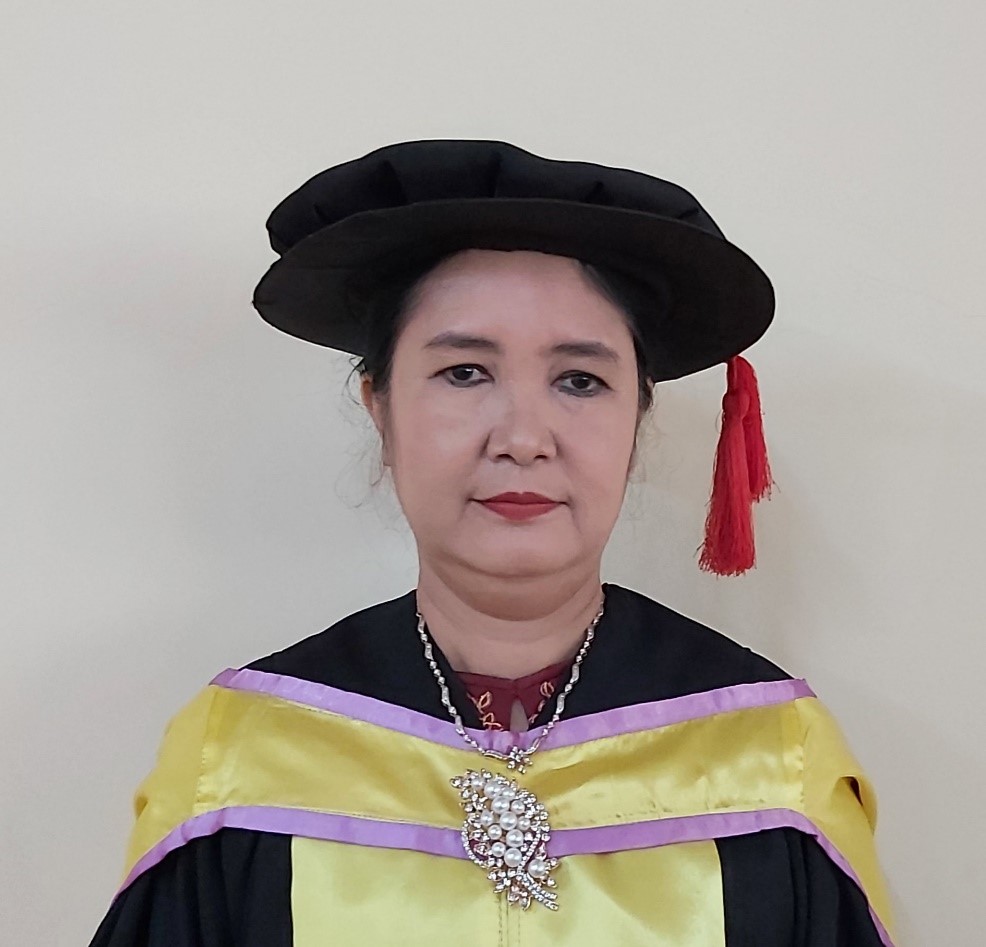
Dr Thandar Oo
ဒေါက်တာသန္တာဦး
Position : Professor (Head)
Degree : B.Sc (Hons;)(Botany),M.Sc(Microbiology), Ph.D (Pharmacognosy),University of Yangon
Botany
Teacher list
| Sr.No | Department | Name | Position | Education | Thesis Title | Field Of Specialization | Current Research Project | Email/Gmail |
| 1 | Botany | Dr. Thandar Oo | Professor (Head) | Ph.D | Pharmacognostic Study of Olax scandens Roxb. | Pharmacognosy | – | [email protected] |
| 2 | Botany | Dr Khaing Myo Myo Su | Professor | Ph.D | – | – | – | – |
| 3 | Botany | Dr Kyi Kyi Khine | Professor | Ph.D | – | – | – | – |
| 4 | Botany | Dr Sabai | Professor | Ph.D | – | – | – | – |
| 5 | Botany | Dr. Yin Yin Khaing | Associate Professor | Ph.D | Phytochemical Study of leaves from Acanthus ilicifolius L. and its Antipyretic Activity | Pharmacognosy | Study on the effect of chemical and natural fertilizers on the production of Solanum lasiocarpum Dunal | [email protected] |
| 6 | Botany | Dr. Yee Yee Nwe | Associate Professor | Ph.D | Isolation of Soil Pseudomonas that can produce plant growth promotin substance | Microbiology | Antimicrobial Activity of Endophytic Bacteria strain from Different Parts of polydonum chinese L. | [email protected] |
| 7 | Botany | Dr. Ni Ni Aye | Associate Professor | Ph.D | Taxonomic study on Poaceae in East Bago Region | Plant taxonomy | study on Morphological Charaeters and uses of Banboo Speeies in Hlegu Township of yangon Region | [email protected] |
| 8 | Botany | Dr. Khin Ohn Myint | Associate Professor | Ph.D | Phytochemical investigation of Passiflora edulis Sims and its htpoglycaemic activity |
Pharmacognosy | Evaluation on the leaves of creeping Burhead plants Echinodorus cordifolius (L.)Griseb |
[email protected] |
| 9 | Botany | Daw Hnain Lai Lai Maung | Associate Professor | M.Sc | Role of biofertilizer form nitrifixation Bacteria in reet nodule of Rhizobium | Microbiology | – | [email protected] |
| 10 | Botany | Daw Mi Mi Aye | Associate Professor | M.Sc | A Comprrative Morphology And Wood Anatomy of Some Myanmar Species of the Genus Quercus | Anatomy | – | [email protected] |
| 11 | Botany | Daw Thi Thi Kyaw | Lecturer | M.Sc | Effect different kinds of Media and sudstraes on the Production of Plcurotus sajor caju L. | Mycology | – | [email protected] |
| 12 | Botany | Daw Khin Nyein Yi | Lecturer | M.Sc | Selection of optimun culture medium insugar cane Tissue Culture technique | Tissue Culture | – | [email protected] |
| 13 | Botany | Daw Nilar San | Lecturer | M.Sc | Pseudomonas and their role in agricultural soil | Microbiology | – | [email protected] |
| 14 | Botany | Daw Sandi Hnit San Hlaing | Lecturer | M.Res | Taxonomic study of Members of sedges family (cyperaceae) in southern area of bago division | Plant taxonomy | – | [email protected] |
| 15 | Botany | Dr Win Theingi Aung | Lecturer | M.Res | In vitro seed germination, callus induction, and Plantlets growth of Bulbophyllumauricomum lindl. Form artifical Pollination |
Plant Tissue Culture |
– | [email protected] |
| 16 | Botany | Daw Khin Mar Win | Assistant Lecturer | M.Sc | Ethanobotanical Application of Bamboo | Ethnobotany | – | [email protected] |
| 17 | Botany | Dr Ni Ni Win | Assistant Lecturer | Ph.D | Production of antimicrobial compound by endophytic bacteria NNW-36 isolated from Lettsomia setosa Roxb. | Microbiology | Antimicrobial Activity of Endophytic Bacteria strain from Different Parts of polygonum chinese L. |
[email protected] |
| 18 | Botany | Daw Khin Khin Phyu | Assistant Lecturer | M.Sc | Study on some freshwater Algae of Dagon University Campus | Microbiology | – | khinkhinphyu1990@ gmail.com |
| 19 | Botany | Daw Ei Pyae Myo win | Demonstrator | M.Sc | Antimicrobical Activity of Endophytic Fungi from Flower of Cutharanthus roseus |
Microbiology | Antimicrobical Activity of Endophytic strain Isolated from Different Parts of Nypa fruticans (Wurmb) Taunb. | [email protected] |
| 20 | Botany | Daw Yee Hmawe Hmawe Aung | Demonstrator | M.Sc | Morphological and Anatomical Changes due to uptake and Accumulation of Heavy Metals (Cd,Pb,Zn)and Elements Analysis in Three Species of Hyperacc mulator Plants |
Morphology Anatony |
– | [email protected] |
| 21 | Botany | Daw Aye Thet Pan Min | Demonstrator | M.Sc | Study on Screening and Isolation of Endophytic Bacteria from Aristolochia indica L. and its Effects | Microbiology | Antimicrobical Activity of Endophytic Bacteria strain from Different. Parts of Polygonum chinese L. | [email protected] |
| 22 | Botany | Daw Nan Wai Oo | Demonstrator | M.Sc | Ethnobotanical Study of Plants used by Kayin Tribe in Rural Villages of Hpa-An Township, Kayin State. | Ethnobotany | Study on the effect of chemical and natural fertilizers on the production of Solanum lasiocarpum Dunal Evaluation on the leaves of creeping Burhead plants Echinodorus cordifolius (L.) Griseb |
[email protected] |
| 23 | Botany | Daw Ya Mamone Aye | Demonstrator | M.Sc | Ehtraction of Natural Dyes from Dye Producing Plants of Taungoo Township, Bago Region | – | [email protected] | |
| 24 | Botany | Daw Chan Myae Thu | Demonstrator | M.Sc | Evaluation of Pharmacognostic Study on Heritiera fomes Buch-Ham. | Pharmacognosy | Study on the effect of chemical and natural fertilizers on the production of Solanum lasiocarpum Dunal Evaluation on the leaves of creeping Burhead plants Echinodorus cordifolius (L.) Griseb |
chanmyaethu.ygn611@ gmail.com |
| 25 | Botany | Daw Mar Lar Htay | Demonstrator | M.Sc | Ethnobotanical Study on same rural area or Dawei Township, Thaninthary region | Ethnobotany | Evaluation on the leaves of creeping Burhead plants Echinodorus cordifolius (L.) Griseb |
[email protected] |
| 26 | Botany | Daw Khet Khet | Demonstrator | M.Sc | Study of Cultivation Methods and Breeedny Avility of Slected Rice varieties in Dagon University Campus |
Horticulture | Study on the effect of chemical and natural fertilizers on the production of Solanum lasiocarpum Dunal | [email protected] |
| 27 | Botany | Daw Ei Thandar Soe | Demonstrator | M.Res | Study on Pollen Morphology and fertility of some species in Mawlamyine Township | Palynology | Study on Morphology Characters and Uses of Bamboo Species in Hlegu Township of Yangon Region |
eithandarsoeeithandarsoe [email protected] |
| 28 | Botany | Daw Hpue Mon Thant | Demonstrator | M.Sc | Study on the Growth of Grafted Luffa acutangula | Microbiology | – | [email protected] |
| 29 | Botany | Daw Hsu Moh Moh Hlaing | Demonstrator | M.Sc | A Taxonomic Study of Some Species Found in Zee Taw Village,Yinmabin Township | Taxonomy | study on Morphological Charaeters and uses of Banboo Speeies in Hlegu Township of yangon Region Evaluation on the leaves of creeping Burhead plants Echinodorus cordifolius (L.) Griseb |
[email protected] |
| 30 | Botany | Daw Aye Pa Pa Myo | Demonstrator | M.Sc | Isolation of Fungi from Soil Samples of Nga-Pu-Taw Township and their Antimicrobial Activity | Microbiology | – | [email protected] |
| 31 | Botany | Daw Hsu Yee Mon Kyaw | Demonstrator | M.Sc | Effect of different fertilizer treatments on vegetative and reproductive growth and seed germination of Solanum macrocospon L. | Horticulture | – | [email protected] |
| 32 | Botany | Daw Phyu Win Ei | Demonstrator | M.Sc | Effect of Inorganic Fertilizer and Organic Manure on the Growth of Vigna unguiculata L.(Yardlong Bean) | Horticulture | Study on the effect of chemical and natural fertilizers on the production of Solanum lasiocarpum Dunal | [email protected] |
| 33 | Botany | Daw Yin Mon Aye | Demonstrator | M.Sc | Taxonomic study on some selected species of Angiosperms in East DagonMyothit Township Yangon Region | Taxonomy | Botanical and Phytochemical Studies, Nutritional value and Antimicrobial properties of Leaves of Operculina turpetham (L.) J.Silva. | [email protected] |
| 34 | Botany | Daw Htay Htay Win | Demonstrator | M.Sc | Comparative Morphological and anatomical Characters of Ocimum Bosicillium L.and Elsholdzia Blanda in aunggoleTownship | Anatomy | – | [email protected] |
| 35 | Botany | Daw Aye Chan Myat | Demonstrator | M.Sc | Morphological and Anatomical Phytochemical studies on Solanum Losio worpum Dunal | Pharmacognosy | Botanical and Phytochemical Studies, Nutritional value and Antimicrobial properties of Leaves of Operculina turpetham (L.) J.Silva. | [email protected] |
| 36 | Botany | Daw Eaindra Chan Myae | Demonstrator | M.Sc | Isolation and characterization of Fungi from Mangrove Soils and their Antimicrobial Activity |
Microbiology | Investigation on Screening and Antimicrobial Activity of Endophytic Fungal Strains from Leaves and Rhizomes of Globba arracanensis Kurz. | ayechanmyat117@gmail. com |
Programmes Offered
- B.Sc. / B.Sc. (Hons) in Botany
- B.Sc. / B.Sc. (Hons) in Microbiology
- M.Sc. and M.Res. in Botany
Training Video
First Year
Second Year
Third Year
Fourth Year
Dagon University Botany students can visit the here link: DU-Botany
Curriculum
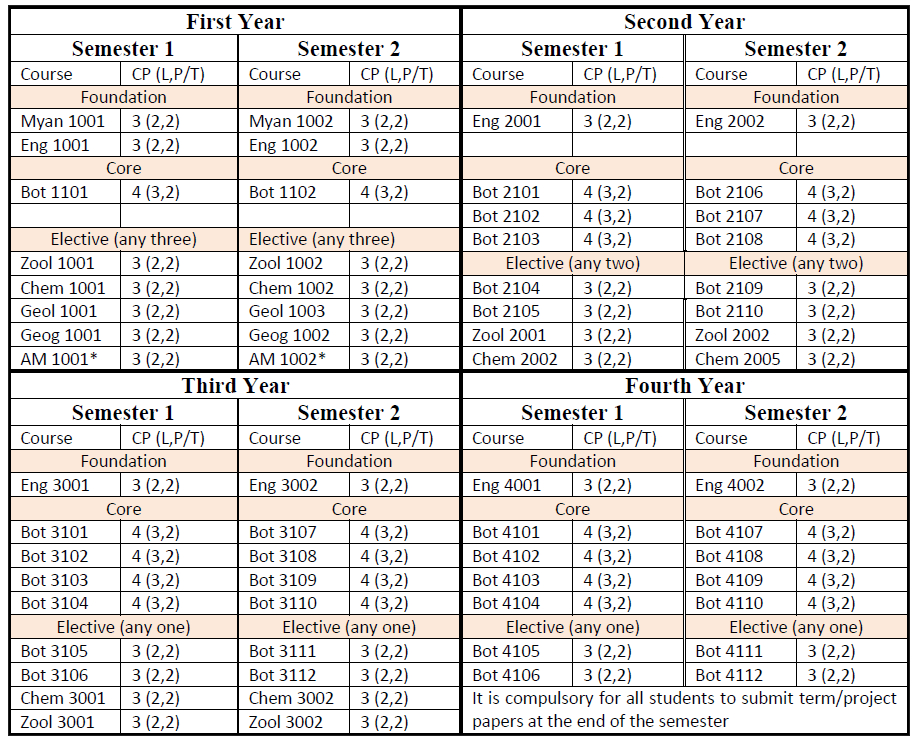
B.Sc. in Botany
B.Sc. (Honours) in Botany
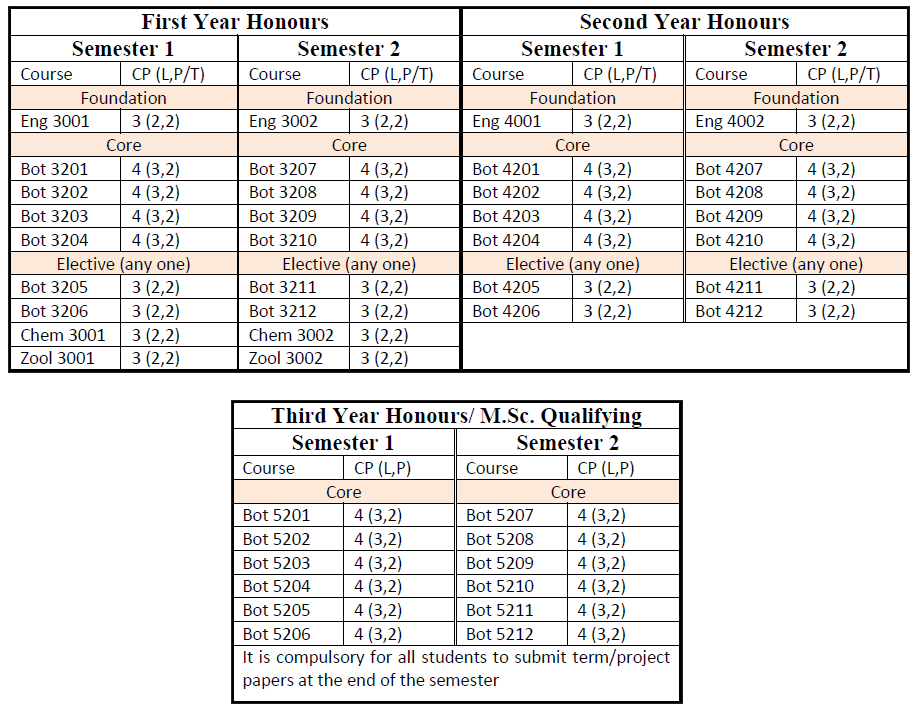
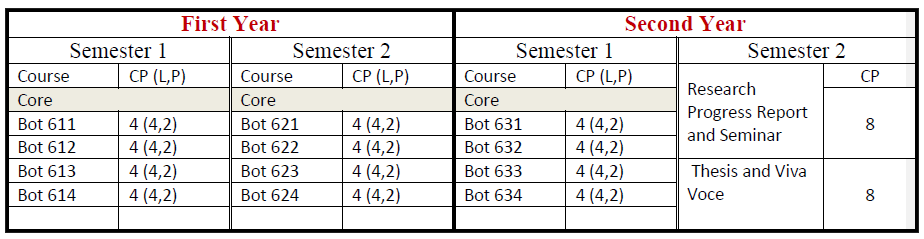
M.Sc. in Botany
Course Descriptions
These modules consist such topics of Mendelian Inheritance; Gene Interaction and Lethality; Allelism and Pleutropism; The Genetics of Sex; Polygenic or Multiple Inheritance Identification of Genetics Material; Chromosome and Chromosome Structure; Linkage and Crossing Over; Polyploidy; and Physical and Chemical bases of Gene Heredity.
In the first part of these modules, students can learn on solutions and colloidal system; diffusion, osmosis and imbibitions; transpiration; water movement in plants; phloem translocation. In the later part, students enhance their knowledge on plant physiology by learning photosynthesis; respiration; growth and development; plant growth regulators; and mineral nutrition.
Weed is a common term for any wild plant, particularly an undesired plant, growing in cultivated ground, where it competes with crop plants for soil nutrients and water. In their natural habitat, wildflowers and herbs not only provide beauty but also function in many useful ways. However, when they invade cultivated areas they often interfere with the desired crop by appropriating space, sunlight, moisture and soil nutrients. Weeds may also harbor and spread insect and fungus pest.
This module covers the structure, organization of the organelles they contain, their physiological properties, metabolic processes, signaling pathways, life cycle, and interactions with their environment. Knowing the components of cells and how cells work is fundamental to all biological sciences, it is also essential for research in bio-medical fields such as cancer, and other diseases. It is closely related to genetics, biochemistry, molecular biology, immunology, and developmental biology.
Cytogenetics is a branch of genetics that is concerned with the study of the structure and function of the cell, especially the chromosomes. Changes that affect the number and/or structure of the chromosomes can cause problems with growth, development, and how the body functions. Changes to chromosome structure can disrupt genes, causing the proteins made from disrupted genes to be missing or faulty. Depending on size, location, and timing, structural changes in chromosomes can lead to birth defects, syndromes or even cancer.
By studying this module, students will gain knowledge on drivers of biodiversity loss; values of biodiversity; wildlife, fisheries and endangered species; and conservation and sustainable use of biodiversity.
The module is composed with sub-titles such as Benefits of Plant Tissue Culture; Equipment for Plant Tissue culture; General Requirements for Growing Tissue in Culture; Types of Plant Tissue Culture; Cryopreservation and Germplasm Storage; Rapid Clonal Propagation; and Production of Secondary Metabolities by Cell Culture
By studying this module, students familiarise with plant nomenclature and taxonomy; classification, identification and histological characters of plants (leaves, stem, root, bark, flower, fruit and seed); preliminary observation; organized (cellular) crude drugs; and unorganized (acellular) Crude Drugs.
This module deals with the structures, functions and interactions of biological macromolecules, such as proteins, nucleic acids, carbohydrates and lipids, which provide the structure of cells and perform many of the functions associated with life.
After finishing this module, students will be able to know importance of research in science, how to formulate and handling problems in research, how to construct research tools and framework, how to survey literature, how to design research, how to analyze, interpret and present the data, how to write reports and research papers.
The module covers ion uptake and transport in plants, mineral nutrition and yield response of plants, function of macronutrients and micronutrients, beneficial of mineral elements, relationship between mineral nutrition and plant diseases, and symptom of deficiency and toxic of mineral nutrients in plants.
The module covers the methods of measurement of microbial growth; microbial screening, selection and strain improvement; the fermentation industry; and biodeterioration
By studying this module, students will gain knowledge on geography of the world, division of the world into floristic region, some general aspects of plant geography, the geological history and past distribution of the flowering plants, the factors of distribution, the theory of tolerance, and the forest of Myanmar.
The module covers the topics on evolution theory, natural selection and variation, speciation, genetic evolution, and population genetics.
Plants are essential to life on earth; they produce the oxygen we breathe through photosynthesis and provide much of the food we eat. Some species provide medicines and promote healing; others are used for insect control or to conserve water. Plants with dense root systems prevent soil erosion and those with brightly colored flowers attract pollinators. Plants have been used to control body functions and fertility, to poison, and to make clothing, paper and rubber. Therefore, the economic plants may be defined as being useful directly, as in food, or indirectly, as products we use or that enhance the environment.
Ethnobotany is the study of the relationships between plants and peoples. It focuses on how plants are used, managed and perceived across human societies. This includes use for food, clothing, currency, ritual, medicine, dye, construction, cosmetics and a lot more.
The module covers such topics on Environmental Education; Environmental Economic, Politics and World Views; Conservation Education and Environmental Ethics.