

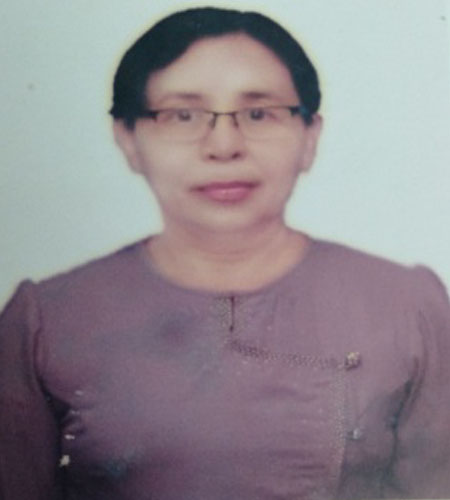
Dr.Nyein Nyein Hlaing
ဒေါက်တာငြိမ်းငြိမ်းလှိုင်
Position : Professor( Head)
Degree : BSc(Hons:),MSc,Ph.D
Zoology
Position : Professor Degree : BSc (Hons:),MSc,Ph.D Position : Professor Degree : BSc(Hons:),MSc,Ph.D Position : Associate Professor Degree : BSc,MSc,Ph.D Position : Associate Professor Degree : BSc,MSc,Ph.D Position : Associate Professor Degree : BSc,MSc,Ph.D Other Information : Dip in Japanese(U.F.L)Dr.Kyi Kyi Maw ဒေါက်တာကြည်ကြည်မော်Dr.Nu Nu Aung ဒေါက်တာနုနုအောင်Dr.Thidar San ဒေါက်တာသီတာစမ်းDr.Moe Sandar Oo ဒေါက်တာမိုးစန္ဒာဦးDr.Kyi Kyi Shwe ဒေါက်တာကြည်ကြည်ရွှေ
Teacher list
| Sr.No | Department | Name | Position | Education | Thesis Title | Field Of Specialization | Current Research Project | Email/Gmail |
| 1 | Zoology | Dr.Nyein Nyein Hlaing | Professor (Head) | Ph.D | Bacteriological Study On Chicken And Pork And Plasmid Profiling Of Antibiotic Resistant Escherichia Coli Isolates | Microbiology | – | [email protected] |
| 2 | Zoology | Dr.Kyi Kyi Maw | Professor | Ph.D | Population and habitat of, mud crab Scyllla serrata (Forskal,1752) in Bogalay and Laputta Townships, Ayeytarwaddy Division | Carcinology | – | [email protected] |
| 3 | Zoology | Dr.Nu Nu Aung | Professor | Ph.D | Development Of Animal Model For Determining The Efficacy And Safety Of Euphorbia hirtai Linn. Used For Amoebic Dysentery | Pharmacology and Parasitology | – | [email protected] |
| 4 | Zoology | Dr.Thi Thi Thaw | Associate Professor | Ph.D | Parasitic infection of some commercially local and exotic ornamental fish | Parasitology | – | [email protected] |
| 5 | Zoology | Dr.Thida San | Associate Professor | Ph.D | Insect Pests Of Spinach, (Hin-Nu-Nwe) Amaranthus Paniculatus, A. Gangeticus, And A. Tricolor | Entomology | – | [email protected] |
| 6 | Zoology | Dr.Moe Sandar Oo | Associate Professor | Ph.D | SomeEcological Aspects Of Sambhur Deer Cervus Unicolor (KERR, 1792) IN Hlawga Wildlife Park, Yangon Divisin | Ecology | – | [email protected] |
| 7 | Zoology | Dr.Kyi Kyi Shwe | Associate Professor | Ph.D | COMPARATIVE ANALYSES ON SERUM PROTEIN,SERUM IRONAND TOTAL IRON BINDING CAPACITY LEVES IN GOAT,CATTLE AND SHEEP UNDER SEMI-CAPTIVE CONDITION | Entomology/Haematology | – | [email protected] |
| 8 | Zoology | Daw Ohnmar Myint | Lecturer | M.Sc | THE ANATOMY AND THE HISTOLOGY OF PAMPUS SINENSIS ( Euphrase, 1788 ) | Ichthyology | – | [email protected] |
| 9 | Zoology | Daw Win Sandar | Lecturer | M.Sc | Economic Catfishes of Ayeyarwaddy River Around Pyay Area | Ichthyology | – | [email protected] |
| 10 | Zoology | Daw Khin Soe Myint | Lecturer | M.Sc | Morphology and reproductive biology of Papilio demoleus | Entomology | – | [email protected] |
| 11 | Zoology | Dr.Yin Min Than | Lecturer | M.Sc | Spatial and temporal distribution of pomace fly species ( Diptera : Drosophilidae) in Yangon Vicinity. | Entomology | – | [email protected] |
| 12 | Zoology | Daw Sabal Khaing | Lecturer | Ph.D | Checklist on Bacteria of Vertebrates | Bacteriology | – | [email protected] |
| 13 | Zoology | Daw Win Win | Lecturer | M.Sc | Study on morphology,pathology and incidence of Dirofilaria immitis infection in Dogs | Parasitology | – | [email protected] |
| 14 | Zoology | Daw Hla Hla | Lecturer | M.Sc | A Taxonomic Study On Some Butterflies Of South Dagon Township | Entomology | – | – |
| 15 | Zoology | Daw Khin Myo Khaing | Lecturer | M.Sc | THE PREVALENCE OF FILARIA INFECTED VECTOR (Culex Quinquefascuatus) IN MYONYWA MYOMA, SAGAING DIVISION | Entomology | – | [email protected] |
| 16 | Zoology | Dr. Thin Thin Yu | Lecturer | Ph.D | DECONTAMINATION OF BACTERIA FROM DRINKING WATER AND NOODLE BY FRUIT JUICES | Microbiology | – | [email protected] |
| 17 | Zoology | Dr.Hnin Hnin Khaing | Lecturer | Ph.D | Energy Dispersive X-ray fluorescence analysis of Minerals and Trace Elements in some Marline Fishes from Tanintharyi Coastal Region.(2009) | Ichthyology | – | [email protected] |
| 18 | Zoology | Dr.Khin Khin Yone | Lecturer | Ph.D | Temporal fluctuation and Spatial distribution of avifauna in Zulun Township and its environs | Ornithology | – | [email protected] |
| 19 | Zoology | Dr.No No Wai | Lecturer | Ph.D | Socio and Molecular Ecology of White-handed Gibbon, Hylobates lar (Linnaeus, 1771) at Ywar Kaing Kaung Village in Dawna Mountain Range Corridor, Hpa-an District in Kayin State, Myanmar | Entomology/Molecular | Comparison of food Diets On The Growth and Analysis of Nutritional Value in Superworm (Zophobas Morio) Larvae | [email protected] |
| 20 | Zoology | Daw Thandar Kyi | Assistant Lecturer | M.Sc | Biology And Induced Breeding In Indian Carp , Labeo rohita | Entomology | – | – |
| 21 | Zoology | Dr.Aye Mi San | Assistant Lecturer | Ph.D | Ecological study of white back planthopper Sogatella Furcifera (Horvath, 1899) in hlegu environs | Entomology | – | [email protected] |
| 22 | Zoology | Dr.Thandar Aung | Assistant Lecturer | Ph.D | Habitat utilization and Relative abundance of Avifauna in Orchard Fish Farm of Maubin Township, Ayeyarwady Region | Ornithology | – | [email protected] |
| 23 | Zoology | U Naing Lin Aung | Demostrator | M.Sc | INDUCED BREEDING WITH SYNTHETIC HORMONE, OVAPRIM AND LARVAL DEVELOPMENT F ANABAS TESTUDINEUS(BLOCH,1792) IN THE LABORATORY CONDITION | Ichthyology | – | [email protected] |
| 24 | Zoology | Daw Shun Lae Yee Myint | Demostrator | M.Sc | MOLECULAR GENETIC VARIATION IN SOME MYSTUS SPECIES OF MAUBIN TOWNSHIP, AYEYARWADY REGION | Molecular | Comparison of food Diets On The Growth and Analysis of Nutritional Value in Superworm (Zophobas Morio) Larvae | [email protected] |
| 25 | Zoology | Daw Thazin Htoo | Demostrator | M.Sc | SEASONAL OCCURRENCE OF SPECIES COMPOSITION AND FISHING GEARS APPLIED OF ICHTHYOFAUNA IN BAGO RIVER SEGENT BETWEEN KAWA AND BAGO AREA, BAGO REGION | Ichthyology | – | [email protected] |
| 26 | Zoology | Daw Hnin Pa Pa Thu | Demostrator | M.Sc | SPECIES COMPOSITION AND SEASONAL ABUNDANCE OF PEST AND PREDATORY SPECIES OF ARTHROPODS ON EGGPLANT CULTIVATION IN NYAUNG AING VILLAGE, ZALUN TOWNSHIP | Entomology | – | [email protected] |
| 27 | Zoology | Daw Theingi Hlaing | Demostrator | M.Sc | – | Ichthyology | – | [email protected] |
| 28 | Zoology | Daw Lwin Mar Naing | Demostrator | M.Sc | STUDY ON SOME ASPECTS OF REPRODUCTIVE PERFORMANCE OF OTOLITHOIDES PAMA, GLOSSOGOBIUS GIURIS AND TAENIOIDES BUCHANANI FROM BAHO SANPYA FISHERIES MARKET, KYEE MYINDAING TOWNSHIP, YANGON CITY | Ichthyology | – | [email protected] |
| 29 | Zoology | Daw Ei Shwe Sin | Demostrator | M.Sc | LARVICIDAL EFFECT OF CARICA PAPAYA (L.) LEAF EXTRACT AGAINST AEDES AEGYPTI(LINNAEUS,1762) LARVAE UNDER LABORATORY CONDITION | Entomology | – | [email protected] |
| 30 | Zoology | Daw Zin Win Mar Tun | Demostrator | M.Sc | TAXONOMIC STUDY ON THE MOTH SPECIES OF ORDER-LEPIDOPTERA IN DAGON UNIVERSITY CAMPUS | Entomology | – | [email protected] |
| 31 | Zoology | Daw Daysi Aung | Demostrator | M.Sc | RECENT SITUATION ON IN VITRO INSECTICIDE RESISTANCE OF AEDES AEGYPTI MOSQUITO IN A SELECTED TOWNSHIP OF NORTHERN YANGON REGION | Entomology | – | [email protected] |
| 32 | Zoology | Daw Naw Wista | Demostrator | M.Sc | SURVEY ON THE PURCHASE VOLUME AND MARKET PRICE OF FRESHWATER AND MARINE FISHES FROM TWO FISH MARKETS, YANGON REGION | Ichthyology | – | [email protected] |
| 33 | Zoology | U Htet Naing Lat | Demostrator | M.Sc | Species composition of Dragonflies in National Races Vialllage and Kandawgyi Natural Park area of Yangon Region | Entomology | – | – |
| 34 | Zoology | Daw Thiri Thwe | Demostrator | M.Sc | BACTERIOLOGICAL PROFILE OF PIG-FISH INTEGRATED FARM, NYAUNG HNIT PIN VILLAGE, HMAWBI TOWNSHIP | Microbiology | Comparison of food Diets On The Growth and Analysis of Nutritional Value in Superworm (Zophobas Morio) Larvae | [email protected] |
| 35 | Zoology | Daw Ju Jue May | Demostrator | M.Sc | SEASONAL ABUNDANCE, COMPOSITIONAND CATCH PER UNIT EFFORT USING GILL NETS, OF FISHES IN THE LOWER PAUNGLAUNG DAM, PYINMANA TOWNSHIP, NAYPYITAW | Ichthyology | Comparison of food Diets On The Growth and Analysis of Nutritional Value in Superworm (Zophobas Morio) Larvae | [email protected] |
| 36 | Zoology | Daw Aye Myat Thazin | Demostrator | M.Sc | Characterization and antibiotic susceptibility of bacteria in dried shrimp from Nandawun market in south Okkalapa township | Microbiology | – | [email protected] |
| 37 | Zoology | Daw Khin Thuzar Win | Demostrator | M.Sc | Characterization of the bacteria in chicken manure from poultry farm in Mingaladon Township | Microbiology | – | [email protected] |
| 38 | Zoology | Daw May Nwe Oo | Demostrator | M.Sc | – | Microbiology | “Antibiotic Sensitivity of Bacterial Isolates in Broiler Chicken from NO.(8) Market at East Dagon Township” | [email protected] |
| 39 | Zoology | Daw Soe Myat Lin | Demostrator | M.Sc | Bacteriological analysis of water tanks in hostels of Dagon Univesrsity | Microbiology | – | [email protected] |
| 40 | Zoology | Daw Win Thi Thi Han | Demostrator | M.Sc | Determination of antimicrobial activity on bacteria isolates from selected yogurt samples | Microbiology | – | [email protected] |
Programmes Offered
- B.Sc. / B.Sc. (Hons) in Zoology
- B.Sc. in Biotechnology
- M.Sc. and M.Res. in Zoology
Curriculum
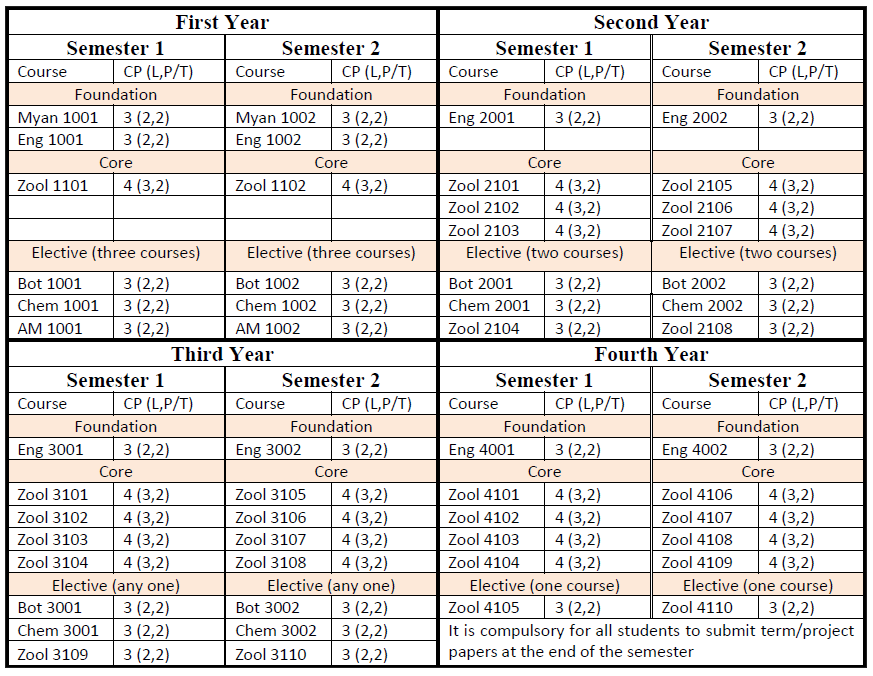
B.Sc. in Zoology
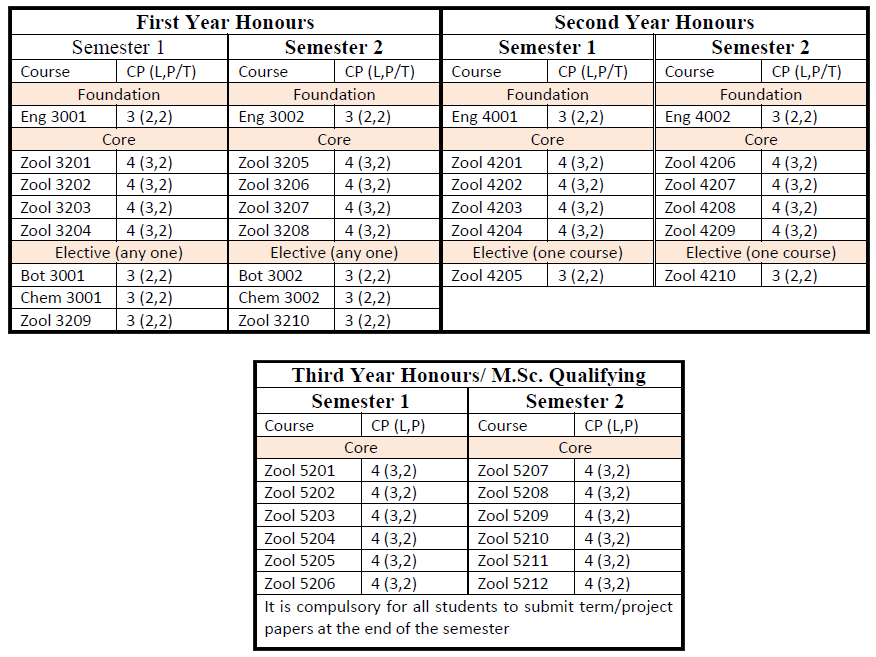
B.Sc. (Honours) in Zoology
Students who passed second year with GPA ≥ 4 are eligible to attend B.Sc. (Honours) classes for three more years. After finished successfully, they earn B.Sc. (Hons) degree majoring in Zoology.
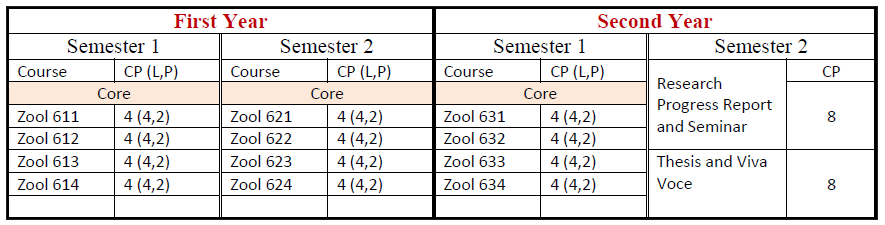
M.Sc. in Zoology
Course Descriptions
This module deals with animal cells, tissues, organs, and variety of life and helps students to understand the modern cell theory as the cell is fundamental unit of life. There includes importance of DNA and RNA structure in cells and will help students to understand the various types of animal tissues in multicellular organisms and to gain knowledge about the organization of tissue and their functions. It also offers the knowledge concerning with structure of organelles and its functions that are importance for human being. This module deals with the kingdoms of life and students will gain knowledge about the classification of six kingdom of life on earth by learning this module.
This module introduced nutrition, cellular respiration, transports and homeostasis of variety of animals. It also covers carbohydrate metabolisms of Krebs cycle and protein synthesis of DNA replication, RNA and protein synthesis. Nutrition components aims at developing students’ ability to understand that all living things are compose of inorganic or organic chemicals and to know the types of digestive system, vertebrate digestive system with its associated glands and their function, to study the physical and chemical digestions in the mammalian gut and to detailed study the vertebrate digestive system with the associated glands and functions.This module help students to understand the cellular respiration is a series of chemical reaction and Krebs cycle take place in mitochondria of cells. Blood circulation is essential parts of our body and gives the knowledge to students for comparative study of vertebrate circulation. Studying the homeostasis aims to gain knowledge about the positive and negative feedback mechanism and to understand how marine and terrestrial animals maintain salt and water balance.
This module reviews ciliated animals of phylum Ciliophora with the classification and other distinctive phenomenon occurred in their life process. The module introduces the students in learning aquatic invertebrates with their modes of life and provides the students to know the difference and similarity on the organs and system of Scypha, Hydra and Obelia.
This module explores the great diversity of the animals that lack a body cavity. Studies on two phyla of acoelomates (Platyhelminthes and Nemertinea) provide students to learn about characteristics, classification, morphology, anatomy, life history and parasitism of some trematodes. Moreover, students will be able to know the background history of animal evolution that depended on the basic plan of most acoelomates.
This module introduces students to the animals that possess a coelom. The invertebrate phylum of Nematoda are studied in sub-titles of general characteristics, morphology of type examples, organs and systems, development and life history, diagnosis and disease, pathogenicity and treatment and prevention. The study of earthworm and Indian cattle leech of phylum Annelida helps students to know the comparison on the structure and organization of these two annelids as well as that of nematodes.
This module covers a general account on aquatic invertebrates of the phyla of Rotifera, Brachiopoda, and Mollusca. The unusual types of morphology, feeding habits, reproduction in rotifers stimulates the students to learn about them compare with branchiopods and mollusks. Moreover, the study of mollusk provides students to know the economic importance of these mollusks.
This module aims to familiarize the students with the biology of the cell. Study on the structure of cell organelles, cytoskeleton, and the movement of the cells provide the students to know principles of cell theory, differences between prokaryotes and eukaryotes cells. This module will enhance the student’s ability to gain full understanding on the function of each organelles and their metabolic activities.
This module deals with the study of a variety of joint-footed animals. Scorpion (chelicerates), Macrobrachium(prawn), Scylla (crab), Periplaneta (Cockroach), Julus (millipedes) and Scolopendra (centipedes) studied with particular anatomical aspects, distribution and development and the different forms of the life cycles. The focus is on understanding the role of the represented species.
This module concerns with the study of a major group of marine animals. Body structure of these spiny-skinned animals stimulate the students to know how this animal had developed their larval stages with embryogeny, how to move and how to do their metabolisms. This module explains relationships between these echinoderms with the hemichordates and their evolutionary convergent.
This module introduces students with animal physiology. It gives the knowledge on how animal work normal function and phenomenon of living thing. The focus is to look comparative animal physiology at the way different animals at several different levels. Students, by studying this module, will be able to know how estuarine invertebrates deal with the constant changes in salinity to which they are exposed.
This module deals with the raring of aquatic organisms. Mariculture’ technologies, coastal aquaculture and its technology will able to extend their knowledge on raring organisms. It enhances the ability of students to gain full understanding on pearl oysters culture with the species description, environmental factors, food and feeding, hatching, nursing, packing and marketing.
This module concerns with the nature and investigation of the diseases. Student can study a variety of pathogens and virulence with their infectious disease and treatments. In addition, the physical, mental and social health, the pathogenesis, varieties of diseases and various types of laboratories specialize in investigating the pathology disease could be studied.
This module introduces how the organisms interact to each other and their environments, and also describes how the individual organisms adapt to its environment. It also deals with the study of the distribution of organisms in various regions and focuses on the factors which control the distribution of animals.
This module offers the general knowledge of insects, structure, habits and habitats and of life cycle of insects of different orders. It helps the students to know the economic importance of insects in agriculture and other sectors.
This module deals with the organisms that take up their food by living in or on other organisms. It helps the students to know the ectoparasites and endoparasites; monogenia and digenia of helminth parasites; the symptoms of disease caused by parasitic organisms; and how to prevent from its infection.
This module introduces the amphibians and reptiles. It includes the key points to identify the poisonous and non-poisonous snakes. Moreover, it also describes the basic breeding and rearing techniques to culture the frogs. The students will be able to apply this knowledge to practice the frog rearing.
This module describes the anatomy, development and behavior of fishes. It also describes aquarium and aquarium fishes in which including the requirements for maintaining and how to set up an aquarium. It helps the students to know the fishing gears and crafts, diseases, economic importance and how to conserve fishes. So the students will apply this knowledge in practical fish culture.
This module aims to understand the geographical and ecological distribution of birds, its ecology, ecological adaptations and reproductive biology. It also deals with the poultry farming and conservation of endangered species.
This module introduces taxonomic characters of 26 mammalian orders down to families and genera taxa levels, how to study the wild animals, geographical distribution, and the factors that control the population size. It also describes mammalian behavior, migration, adaptation, and conservation status.
This module deals with the genes which control the hereditary traits transmitted from parent to its progeny. It includes problems and solution to understand the cross of genes. It also describes the chromosome theories of inheritance, interaction of genes, and how to determine the sexes.
This module offers the knowledge about the evolutionary change of organisms. It describes various theories, types of isolation, types of mutation, and genetic variation. The focus is placed on how the organisms change in their evolutionary trend and why the new species arise.
This module deals with the study of development of animals. The students not only can review on gametogenesis and egg types but also can study on fertilization, embryonic development and differentiation of amphibians. Student will be able to study how the other vertebrates developed from the fertilized egg to the adult forms.
This module offers a general knowledge of endocrine system, its diseases and its specific secretions and psychological or behvioural activities of metabolism. It focuses on the major endocrine gland and their hormones, target tissue and their responses, and location and functional diseases of these endocrine glands. Students are able to learn the communication between different parts of the body caused by nerve fibers and hormones.
This module concerns with the global and national overview of the status of biodiversity. It also deals with ecology diversity, species diversity, and genetic diversity and enables the students to understand the importance of biodiversity, value of biodiversity and ecosystem services. Students will gain knowledge and awareness on the importance of conservation for threat animals at Myanmar biodiversity.
This module first examines a range concerning viruses: what their characteristics are, how they are classified, how they replicate, what role they play in some kinds of cancers, how they maintained in the laboratory, and whether viruses are alive. The students enable to study a history of microbiology, the chemistry of microbiology as well as beneficial microbes.
This module focuses on the theories for conducting a research problem. It also motivated students to learn in identification and analyzing the research problem and technique using in research problem. The students can learn why literature survey conducted in research, which study design used, how to collect the samples, how to analyze the samples, and how to interpret their data.
This module covers such topics as recombination among linked genes, genetic mapping, linkage estimation, and use of genetic map. Students will have knowledge on how the genes ordered in chromosome, what events happened during cell division, and what factors contributed to crossover rate.
The purpose of this module is to introduce students to animal physiology. Students will learn the animal’s structure and organization, energy transformation, heat control in animals, transport of water and solutes, plasma membrane transport. This module also provides students the knowledge about how to conduct the daily rhythmically function, and how to control the homeostasis in daily life.
This module includes components of immune system, and antigens and antibodies. Student will study relationship of antibodies and humoral immunity. It also provides the students for understanding about T- cells and cell mediated immunity, immunodeficiency and immune phenomena and medicine.
This module deals with theories of natural selection and origin of species. Some aspects of evolution on Darwinian and genetic meaning of fitness, natural selection, types of selective processes, speciation, and the role of micro evolution included in this module and provides the student to understand how recent animals evolved.
This module concerned with the study on the remains of animals and plants of past ages, mineral character of the skeleton with typical examples of fossils. The purpose of this module is to enable students to learn about the fossil animals lived in different geological time with their geological distribution.
The module introduces technologies of biology to the students. This module helps the students to familiarize with varieties of techniques and methods on DNA sequencing, cloning, genetic engineering experiment, biochips, stem cells and ethics and regulation. It also trains the students to conduct the study work using these techniques.
This module introduces fundamentals of biostatistics and practical statistics. It will help students to understand the various types of parametric and non-parametric analyses and tests and sampling distribution. The students will be able to analyze the data of their research by using student’s t Test, Chi-square Test, Z Test, Mann-Whitney U Test, and Spearman’s correlation test.
This module offers the species category; species concepts; species name; difficulties in the application of the biological species concept; importance of polytypic species; systematic collection; the qualitative and qualitative analysis of variation, ecological variation, traumatic variation, genetic variation, sex-associated variation, non- sex-association individual variation.
This module offers the Geologic eras; Holarctic region; Neogaea; Notogaea; Celebes, the Moluccas and the lesser sunda islands.
This module offers physical structure of the genetic material; cytoplasm in heredity and development; mutation; quantitative genetics; types of gene action; heritability; and evolutionary genetics.
This module deals with the experimental design; replication and randomization, randomized design, stratified radon sampling, systematic randon sampling, confidence limit; definition of statistics in biology, the use of statistical test in research, hypothesis testing, the null hypothesis, alternative s vs controls, decision errors, and the P value.
This module concerned with the respiratory, cardiovascular and renal functions; mechanism of respiration; alveolar ventilation; regulation of respiration, the cardiovascular system; the heart pump; blood pressures; the urinary system; renal water balance; thermoregulation and metabolism; endocrine and reproductive function.
This module offers the freshwater environment: types and limiting factors; ecological classification of freshwater organism; marine ecology; estuarine ecology, terrestrial ecology; population and environmental health; competition and other population interactions
This module deals with the breakdown of isolation mechanism; hybridization as a population phenemon; Causes of the breakdown of isolation mechanism; kinds of variation; observation and measurement of behavior; maintenance behavior and temporal considerations; spatial aspects of behavior; foraging and antipredator behavior.
This module is dealt with the bacteria; the viruses; water microbiology; food microbiology; veterinary microbiology; infection and resistance to infection.
This module consists of fish embryology, amphibian embryology, reptilian embryology, avian embryology and mammalian embryology.
This module comprised the insect endocrinology with emphasis on insect endocrine gland; hormones in invertebrate, vertebrate endocrinology: Introduction, general organization of vertebrate endocrine system, endocrine control of neural functions, some modern concepts and problems; pituitary gland-anatomy, biological actions of adenohypophysis and neurohypophysis; anatomy and physiology of thyroid gland; anatomy and physiology of insulin and glucagon; adrenal gland: chromatin cell hormone-physiology of adrenal cortex and adrenal medulla; Gonads-hormones and effects; mammary gland and lactation; gastro-intestinal hormones; and organs of uncertain endocrine function.
This module deals with the observation and measurement of behavior; maintenance behaviour and temporal vonsiderations; dpatial aspects of behaviour; foraging and antipredator behaviour; behaviour in social groups; and behavoiur relationships between human and other animals.
This module offers students to environmental ethics; physical and biological processes on earth; natural hazards; environmental planning.