
Dagon University

ဒဂုံတက္ကသိုလ်

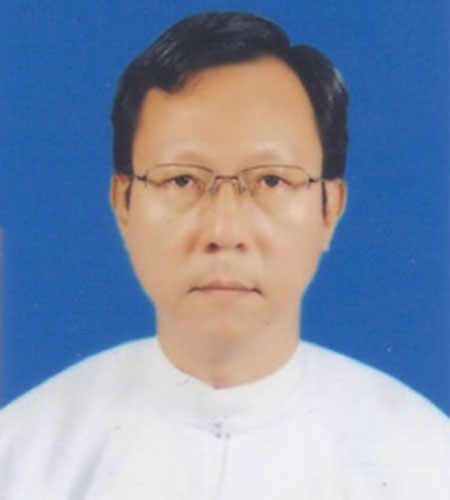
Dr. U Win
ဒေါက်တာဦးဝင်း

Position : Professor (Head)

Degree : Ph.D (Physics)

Other Information : Field of Study - Electronics

Physics

Dr San San Swe ဒေါက်တာဒေါ်စန်းစန်းဆွေ

Position : Professor

Degree : Ph.D (Physics)

Other Information : Field of Study - Materials Science

Dr Aye Aye Hnin ဒေါက်တာအေးအေးနှင်း
Position : Professor Degree : PhD (Phys) Other Information : Field of Study - Nuclear Physics
Dr Nyo Nyo ဒေါက်တာညိုညို
Position : Professor Degree : Ph.D (Physics) Other Information : Field of Study -Materials Science
Dr Kywe Kywe Aung ဒေါက်တာ ကြွယ်ကြွယ်အောင်
Position : Professor Degree : Ph.D (Physics), DCSc Other Information : Field of Study - Nuclear Physics

Teacher list

Sr.No Department Name Position Education Thesis Title Field Of Specialization Current Research Project Email/Gmail
1 Physics Dr Kywe Kywe Aung Professor  (Head) PhD Determination of Concentrations of Elements in Some Medicinal Plants for Hypertension and Diabetes by EDXRF Method Nuclear Physics [email protected]
2 Physics Dr Aye Aye Hnin Professor PhD Color Center Formation and Moonstone by Gamma Ray Treatment Nuclear Physics [email protected]
3 Physics Dr Nyo Nyo Professor PhD Fabrication and Ultraviolet Fine Fibers by Electrospiring Method Materials

Science

[email protected]
4 Physics Dr Phyu Phyu Khaing Associate Professor PhD Intelligent Gas Leakage Detection and Mitigation System with Automated Ventilation Control Electronics [email protected]
5 Physics Dr Kyaw Hlaing Associate Professor PhD Keyboard Controlled Scoreboard Electronics [email protected]
6 Physics Dr Hnin Thida Soe Associate Professor PhD Particle-Size Analysis of Soils by Gamma Ray Attenuation Method Nuclear Physics [email protected]
7 Physics Dr Tin Tin Mya Associate Professor PhD Characterization of Sol-Based Growth Sr (10 mol%) Doped BaTiO3 Thin Film Devices Materials
Science
[email protected]
8 Physics Dr Aye Aye Moe Associate Professor PhD Characterization of Spray Pyrolysed MgCu Ferrite Thin Film Materials
Science
[email protected]
9 Physics Dr Sabai Lecturer PhD Electrical Characteristics of  N-Channel FET with Al (3 mol%) Doped PbTiO3 Gate Material Materials
Science
[email protected]
10 Physics Daw Than Shwe Lecturer MSc Classical Configuration in Nuclei Nuclear Physics [email protected]
11 Physics Daw Kyi Kyi Soe Lecturer MSc Nuclear Radiation Detectors Nuclear Physics [email protected]
12 Physics Dr Wut Hmone Win Lecturer PhD Growth and Characterization of K2SxCr1-xO4 Crystal Materials
Science
[email protected]
13 Physics Dr Khin San Lwin Lecturer PhD Study Of Ca Doped BaTiO3, Epilayers on SiO2/Si for Ferroelectric Field Effect Transistor Applications Materials
Science
[email protected]
14 Physics Dr Thi Thi Swe Lecturer PhD Growth and Characterization of Manganese-Doped Barium Titanate Thin Film Capacitors for Memory Device Applications Materials
Science
[email protected]
15 Physics Dr Thida Lwin Lecturer PhD CdS/CdO/Glass Thin Film Materials
Science
[email protected]
16 Physics Daw Win Win Ei Lecturer MSc Electronic Door Lock Electronics [email protected]
17 Physics Dr Mon Mon Swe Lecturer PhD Analysis of Global Optical Model Parameters for Heavy Nuclides Using EMPIRE/ABAREX Nuclear Physics [email protected]
18 Physics Dr Htay Htay Pyone Lecturer PhD Maximum Power Tracking for Photovoltaic System Electronics [email protected]
19 Physics Dr Aung Myo Khine Lecturer PhD Development of a Method for Automatic Dosing of Phosphates in a Boiler Drum Depending on the Flow Rate and Quality of Feed Water Thermal Physics [email protected]
20 Physics Dr Khine Thandar Min Lecturer PhD High Temperature
Ionic Conductivity
and Dehydration
of Li3+/NiSO4.7H2O Crystal
Materials Science [email protected]
21 Physics Dr Khin Swe Oo Lecturer PhD Gas Sensor Based on SnO2 Nanoparticles Materials
Science
[email protected]
22 Physics Dr Khin Sandar Thein Lecturer PhD Characterizations  and Solar Cell
Application of  Sol-Gel Based
Growth  Zn1-xCdxS Thin Film
Materials
Science
[email protected]
23 Physics Dr Thin Shwe Sin Myint Lecturer PhD Analysis of Optical Model Parameters for K-39 Nuclear Physics [email protected]
24 Physics Dr Htet Htet Thu Lecturer PhD Characterization of
NiO Thin Film
Materials
Science
[email protected]
25 Physics Dr Su Su Naing Lecturer PhD Characterization of
Spray Pyrolysed MgZn Ferrite
Thin Film
Materials
Science
[email protected]
26 Physics Dr Phyu Phyu Zan Lecturer PhD Hamiltonian  Dynamics in Braneworld Structure Theoretical
Physics
[email protected]
27 Physics Dr Phyo Phyo Kyi Lecturer PhD Synthesis and Characterization of Nickel-Zinc and Maganese-Zinc Ferrites Nano Particles Materials
Science
[email protected]
28 Physics Dr Khin Phyu Win Lecturer PhD Digital Signal Processing by a Microcontroller-Based Data Acquisition Device Electronics [email protected]
29 Physics Dr Aye Myint Myat Kywe Assistant Lecturer PhD TiO2 Thin Film for Dye Sensitized  Solar Cell
(DSSC) Application
Materials
Science
[email protected]
30 Physics U Zaw Min Tun Demonstrator MSc Green Synthesis of Silver Nanoparticles Using Centella Asiatica(L)  Leaf Extract and their Antimicrobial Activities Materials
Science
[email protected]
31 Physics Daw Hnin Wut Yi Demonstrator MRes Investigation of the Elemental Concentration in Tobacco Leaves by EDXRF Method and AAS Technique Nuclear Physics Enhancing Electrochemical Performance of  Supercapacitors through Structural Optimization of Laser Induced Graphene [email protected]
32 Physics U Nay Lin Tun Demonstrator MSc Investigation on Properties of Natural Dyes (Chrysanthemum, Marigold and Turmeric) for Organic Dye Sensitizer Materials
Science
[email protected]
33 Physics U Than Min Oo Demonstrator MSc Design and Construction of PIC 16F628A Based Three Channels Remote Control System in Mikro C Pro Electronics [email protected]
34 Physics Daw Khin Win Oo Demonstrator MSc Optical Properties of Kok-Ko and Thayet Dyes for Dye-Sensitized Solar Cells Materials
Science
[email protected]
35 Physics U Ye Htet Paing Demonstrator MSc Arduino Based Temperature and Heart Beat Measured Using Temperature Sensor and Heart Beat Sensor Displaced in LCD Electronics [email protected]
36 Physics U Than Htike Demonstrator MSc I-V Characteristics of Titanium Dioxide (TiO2) Based Dye- Sensitized Solar Cell Materials
Science
[email protected]
37 Physics Daw Lae Lae Win Demonstrator MSc Calculation of Charge Density Distribution for 197Au by Using 2PF and 3PF Models Nuclear Physics [email protected]
38 Physics Daw Phyu Hnin Phway Demonstrator MSc Construction of Radio Frequency Identification (RFID) Based Attendance System Using Arduino Electronics   [email protected]
39 Physics Daw Shwe Zin Kyaw Myint Demonstrator MSc Automatic Fire Extinguishing System Using PIC and Sensor Modules Electronics [email protected]
40 Physics Daw Pyae Pyae Phyo Demonstrator MSc Bluetooth Controlled Home Automation System Using Arduino Electronics [email protected]
41 Physics Daw Thuzar Nwe Demonstrator MSc Design and Construction of Disco Light Circuit using PIC 16F84A Electronics [email protected]
42 Physics Daw Lwin Lwin Myint Demonstrator MSc Design and Construction of Outdoor Light Controller Using LDR Sensor Electronics [email protected]
43 Physics Daw Ei Thandar Phyo Demonstrator MSc Characterization of Natural Dye from Dragon Fruit Using UV-VIS Spectroscopy Materials
Science
[email protected]
44 Physics Daw Hnin Wutyi Linn Demonstrator MSc Study on Structural Morphological and Optical Properties of ZnTiO3 Perovskite Films Materials
Science
[email protected]
45 Physics Daw Khin Khin Htwe Demonstrator MSc Digital Voltmeter Using PIC 16F877A Microcontroller Electronics [email protected]
46 Physics Daw Khin Yu Nwe Demonstrator MSc RFID and Password Based Dual Security Access Control System Using Arduino Electronics [email protected]
47 Physics Daw Aye Thandar Tun Demonstrator MSc Analysis of Heavy Metal
Contamination in
Commercial Fruit
Juice Using As and Pb
Nuclear Physics [email protected]
48 Physics Daw Mya Mya Zan Demonstrator MSc An EDXRF Study of the Elemental Concentration of Toothpaste in Myanmar Quantum Mechanics [email protected]
49 Physics Daw Thaw Tar Ngwe Zin Demonstrator MRes Simultaneous Display of Voltage on the Serial Monitor and LCD Display Electronics [email protected]
50 Physics Daw Wint Yee Phyo Demonstrator MSc Construction of  Automatic
Bascule Bridge   (Arduino Based)
Electronics   [email protected]
51 Physics Daw Lae Shwe Yee Khaing Demonstrator MRes Fabrication of Pb (Zr,Ti) O3 Thin Film For Non-Volatile Momery Devices Application Materials
Science
[email protected]
52 Physics Daw Ei Mon Kyaw Demonstrator MSc Stability of Light Nuclei with Binding Energy and Packing Fraction Theoretical Nuclear Physics [email protected]
53 Physics Daw Shwe Yi Win Demonstrator MSc Voice Control of Home Automation System Using
Android and Arduino
Electronics [email protected]
54 Physics Daw Yadana Phyo Wai Demonstrator MSc Design and Construction of Social Distancing Indicator Utilizing Arduino Pro Mini Electronics [email protected]
55 Physics Daw Moe Pwint Phyu Demonstrator MSc Effect of Calcination Temperature on the Properties of Bismuth Vanadate Powder Materials
Science
[email protected]
56 Physics Daw Hnin Rawai Kyaw Demonstrator MSc Design and Construction of Programmable DC Motor Control System Electronics [email protected]
57 Physics Daw Soe Soe Than Demonstrator MSc Design and Construction of  the DC Fan Speed Control System Using IR Remote Control Electronics   [email protected]
58 Physics Daw Aye Aye Aung Demonstrator MSc Synthesis and Characterization of Heterogeneous CdO-NiO Nanocomposite Thin Film Materials
Science
[email protected]
59 Physics Daw Hsu Mon Ko Demonstrator MSc Investigation of Energy Usage in Some Fields Nuclear
Physics
[email protected]
60 Physics Daw Aye Thein Wai Demonstrator MRes Design and Development of Computer Based Data Reading and Writing System in Visual Basic Window Forms Electronics [email protected]
61 Physics Daw Hla May Than Demonstrator MSc Arduino Based Temperature Control System for Smart Home Electronics [email protected]
62 Physics Naw Htoo Bwe Demonstrator MSc Design and Construction of Wind Turbine Charging Controller Electronics [email protected]
63 Physics U San Nyunt Wai Demonstrator MSc Design and Construction of Object Counting System by Using Light Dependent Resistor Electronics [email protected]
64 Physics Daw HoneyTun Shwe Demonstrator MSc New Contribution  to the Nucleus – Nucleus Potentials  for Heavy Ion  Fusion Reactions Nuclear Physics   [email protected]
65 Physics Daw Lae Lae Win Naing Demonstrator MSc Calculation of Charge Density Distribution And Form Factor of Silicon (28Si14) Theoretical
Nuclear
Physics
[email protected]
66 Physics Daw Zin Mar Myint Demonstrator MSc Structural Properties of II-VI Ternary Compound ZnCdS Ceramics Materials
Science
[email protected]
67 Physics Daw Moh Moh Hlaing Demonstrator MSc Microcontroller Based Binary To Decimal Converter Electronics [email protected]
68 Physics Daw Thi Thi Aung Demonstrator MSc Determination of Heavy Metals Concentration  in the Sediments
from Ayeyarwaddy River and Near  Mandalay Region
Nuclear
Physics
[email protected]
69 Physics Daw Yae Mar Soe Demonstrator MSc Preparation and Characterization of Molarity Based ZnS-ZnO Nanocomposite Films Materials
Science
[email protected]
70 Physics Daw Lai Lai Naing Demonstrator MSc Determination of Indoor  Radon Concentration in Different Buildings at Pakokku University Campus by Using SSNTDS Nuclear Physics [email protected]
71 Physics Daw Tine Yine Soe Demonstrator MSc Analysis of Elemental
Concentration and
PH Level in Ground Water
Near Taunggoke
Degree College
Nuclear Physics   [email protected]
72 Physics Daw Hnin Ei Ei Win Demonstrator MSc Sol-Gel Synthesis and Characterization of Copper Substituted Zinc Ferrite Materials
Science
[email protected]
73 Physics Daw Sa Bal Khaing Demonstrator MSc Design and Construction of LED Chaser by Using PIC 16F84A Microcontroller Electronics [email protected]
74 Physics U Ko Ko Htun Demonstrator MSc Microstructural Properties of TiO2-ZnO Binary Composites by Mechanochemical Milling Process Materials
Science
[email protected]
75 Physics Daw Tharaphi Kyaw Demonstrator MSc Smart Restaurant Menu Ordering and Robotic Serving System Electronics [email protected]
76 Physics Daw Chaw Klayar Hlaing Demonstrator MRes Deposition and Spectroscopic Ellipsometry Measurement of SnO2:F Thin Film Materials
Science
[email protected]
77 Physics U Aung Win Htay Demonstrator MSc Visualization and Measurement of Some Weather  Parameters Using ESP32 and Processing Software Electronics [email protected]
78 Physics Daw Mi Mi Tun Demonstrator MSc Inverse Square Relationship between the Distance and Radiation Intensity of GM Counter with Various Radiation Sources Nuclear Physics   [email protected]
79 Physics Daw Yu Mon Khaing Demonstrator MSc Investigation of Radon Concentration in Some Fertilizer Samples Nuclear EMP [email protected]

Programmes Offered

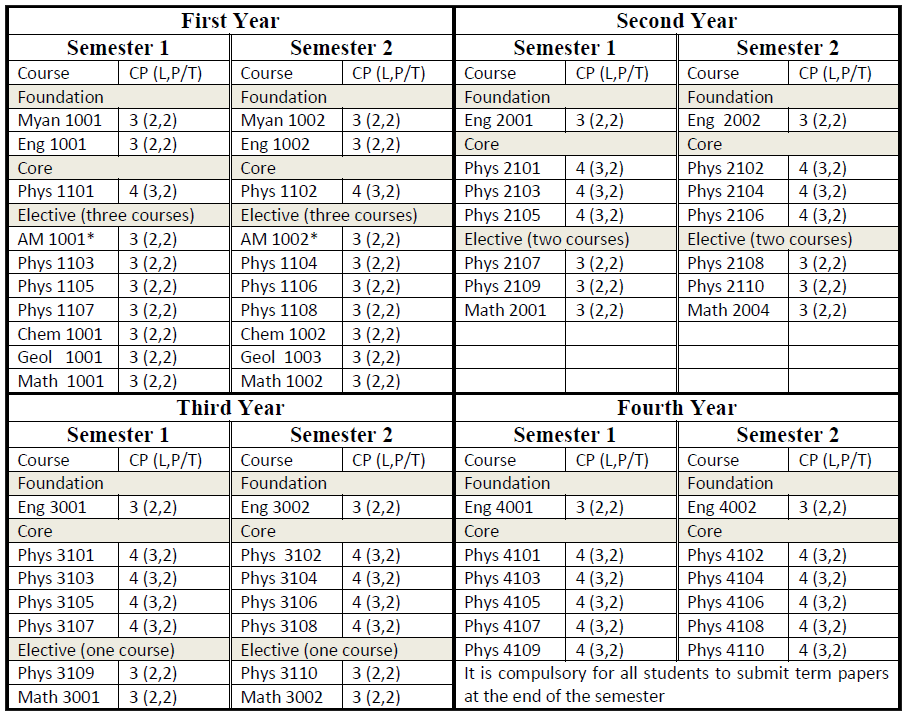
Curriculum

B.Sc. in Physics

B.Sc-Physics

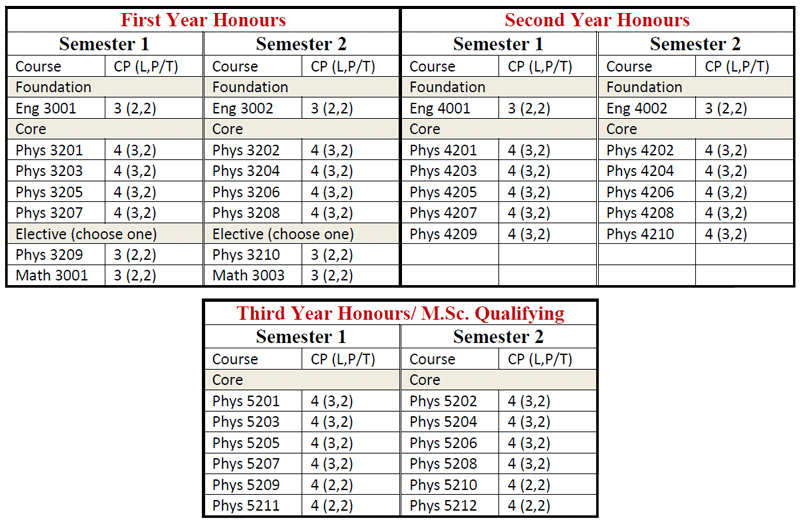
B.Sc. (Honours) in Physics

Students who passed second year with GPA 4 or GPA greater than 4 are eligible to attend B.Sc. (Honours) classes for three more years. After finished successfully, they earn B.Sc. (Hons:) degree specializing in Physics.
B.Sc(Hons)-Physic

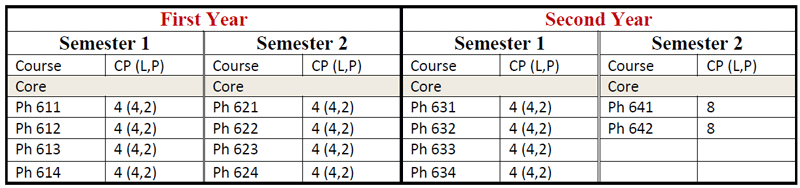
M.Sc. in Physics

M.Sc-Physics

Course Descriptions

The module deals with Motion in a Plane: Components of Motion, Projectile Motion, Uniform Circular Motion and Centripetal Acceleration; Forces: Newton’s Law of Gravitation, a closer look at gravity, apparent weightlessness; Friction: Causes and Types, Coefficients of Friction, Air Resistance; Work, Energy and Power: Work, Energy, The Conservation of Energy, Power; and Rotational Motion and Dynamics: Description of Rotational Motion, Torque and Moment of Inertia, Rotational Wok, Power, and Kinetic Energy, Angular Momentum. It is also concerned with Sound: The Nature of Sound, Sound and Hearing, Sound Phenomena; Fluid Mechanics: Fluid Properties, Pressure and Pressure Measurement, Buoyancy and Archimedes’ Principle, Fluid flow;and Thermodynamics, Heat Engines & Pumps: The First Law of Thermodynamics and Thermodynamic Processes, The Second and Third Laws of Thermodynamics.
This module covers Light and Illumination: The Nature of Light, Interference, Diffraction, Polarization, Illumination; Basic dc Circuits: Resistances in series and parallel, Kirchhoff’s rules and multiloop circuits, Voltage Sources in series, Circuit Applications; and Solar Energy Technology: Solar Radiation, Electricity from solar energy, solar heating and cooling.
The module includes Elements of AC Circuits & Electronic Circuits: Reactance, Impedance, Resonance & Power Factor, Electrical Power, Transmission, House-hold Circuits, Electrical Safety, Personal Safety & Electrical Effects, Ground- Fault Interrupter.
This module is concerned with Electronics and Solid State Device: The Electron Tube, Solid State Devices, Printed Circuits and Integrated Circuits, Light Emitting Diodes, Xerography & Electrostatic Copiers; and Modern Physics: Intrinsic Semiconductors, Compound Semiconductors, Junction Diode, n-p-n Transistors, p-n-p Transistors, Rectifiers, Amplifier.
The module deals with Radio, TV and Computer: Radio, Woofer and Tweeter, Television, LCDs – Liquid Crystal Displays, Radio Telescopes, Computer.
The module focuses on Quantum Physics and the Dual Nature of Light: The Ultraviolet Catastrophe & Quantization, Photo Electric Effect & De Broglie Wave-Particle Duality & Bohr H-Atom Theory, Laser Experiments with (a) bullets (b) waves (c) electrons, Probability and Probability Amplitude, Electron Microscope; and Relativity: Space (x1, x2, x3),Time(ct = x0)and Matter (E/c2), Pre-Newtonian Space & Time, Lorentz, Fitzgerald and Larmor’s Concepts of Space and Time, Einstein and Minkowski’s Space-time, Twin Paradox Doppler Shift, Red Shift, Lorentz Transformation, Four Vectors.
This module is concerned with The Universe, Galaxies and Planets, Formation of Chemical Elements, Nucleo-synthesis, New Planetary System, The Solar System, The Planetary Orbits, The two body problem, The Orbit Equation, The Gravitational Attraction, The Escape Velocity, Projectile Motion, Space Travel, Is there a beginning? Worm holes and Black holes, and Cosmology.
The module includes Vector Analysis: Vector Algebra, Vector differentiation, gradient, divergence and curl, Curvilinear coordinates, Vector integration, Divergent Theorem & Stokes’ Theorem; and Ordinary Differential Equation: First order differential equations, Second order differential equations, Series solutions, Applications.
The module covers Elementary Computing Concepts: PC basic, Introduction to MathCAD / Mathematica; Essential Programming Concepts: variables, arrays, block structure, subroutines and functions, compile-link-debug cycle, Pseudo Language / C Language, excluding obscure features, Top-down approach to program design, Programming examples chosen from the physical sciences; and Numerical Technique: Finite diffuseness, Newton’s formulae, Numerical integration, Solution of algebraic and transcendental equation.
The module focuses on The Static Electric Field: Part 1, The Static Electric Field: Part 2, The Steady Electric Current, and The Static Magnetic Field of Steady Electric Currents.
This module deals with Applications of Thermodynamics, Unit Systems, First Law of Thermodynamics, Heat and Specific Heat, Specific Heats for Ideal Gases, Processes for Ideal Gases, and Quasistatic-Adiabatic Process. It is also concerned with Equation of State, Thermal Expansions, Physical Description of the Second Law, Kelvin-Planck and Clausius Statements, Reversible Processes and Cycles, Sign Convention of Heat and Work, Macroscopic Definition of Entropy, Principle of Increase of Entropy, Change in Entropy for an Ideal Gas, and Carnot Cycle. It includes Third Law of Thermodynamics, The Kinetic Theory of Gases, Molecular Model of an Ideal Gas, Molar Specific Heat of an Ideal Gas, Adiabatic Processes for an Ideal Gas, The Equipartition of Energy, The Boltzmann Distribution Law, and Distribution of Molecular Speeds/ Mean Free Path.
The module focuses on Atoms, ions and Electrons, The special theory of relativity, Properties of electromagnetic radiation, Waves and particles, The hydrogen atom, Optical spectra and electronic structure, and X-ray spectra.
The module deals with Static of bodies, Work & potential energy, Motion with air resistance, Oscillations, resonance and phenomenon vibrations, Systems of particles, linear and angular momentum, Motion of rigid body in plane, Central force motion, Gravitational Potential, Orbital motion, Black holes, and Generalized co-ordinates.
The module is about Microstates and degeneracy, distinguishable and indistinguishable particles, Thermodynamic functions of state, distribution functions, Entropy, disorder and the probability of system configuration occurring, and Information theory. It also includes Arrow of time, Equilibrium configuration, Boltzmann distribution, Temperature, Partition function, One-dimensional harmonic oscillator, Planck distribution, Black body radiation, Fermi-Dirac and Bose- Einstein distributions.
The module is concerned with Interference fringes from a double Source, Intensity Distribution in the firing System, Fresnel’s Biprism; Interference: Involving Multiple reflection , Reflection from a plane parallel Film, Fringes of Equal Thickness, Newton’s rings; Fraunhofer Diffraction by a single Opening: Diffraction by a single slit, The Diffraction Grating; Lasers- Stimulated Emission: Laser Design, The Ruby Laser, The Helium Neon Gas Laser.
This module covers Pre Newtonian Physics, Newtonian Gravity, Newtonian Space-time, Michelson & Morley Experiment, Motion in Mechanics, Einstein’s Space-time, and Four vectors in Special Relativity.
The module is about Lorentz Transformations, Phase velocity, wave velocity, group velocity, Relativistic kinetic energy, Length, Mass and Time in Special Relativity, and Addition of velocities. It also includes Energy moment-four vectors, The twin paradox, Introduction to curved space-time, and Gravitation as curved space-time phenomenon.
The module is concerned with Sinusoidal steady state response of circuits, and Thevenin and Norton theorems.
The module focuses on Diode applications, Special-Purpose Diodes, Bipolar Junction Transistors (BJTs), Transistors Bias Circuits, and BJT Amplifiers.
The module covers Nuclear properties, Nuclear models, Nuclear forces, Nuclear energy, Nuclear reactions, Particle accelerators, and Nuclear radiation detectors.
This module includes Nuclear disintegration, Decay processes, Elementary particles and quarks, Introduction to radiation protection, Health Physics, and Radiological Physics.
The module focuses on Mechanics of a system of particles and constraints, and The generalized coordinates.It also deals with D’Alembert’s principle and Lagrange’s equation, Euler Lagrange eqn, Hamilton’s principle, Hamilton’s principle for a conservative system, Principle of least action, Hamilton’s equations, Ignorable coordinates, Characteristic Functions and Hamilton-Jacobi Eqn, Special transformations, Lagrange Brackets, and Poison’s brackets.
The module is concerned with Developments in Quantum Theory, Blackbody Radiations, Rayleigh-Jean’s Law, Photoelectric & Compton Effect, X-ray, Neutron, Electron Diffraction, Wave Packets & De Broglie’s Waves, Probability Amplitudes, Probability in Classical & Quantum Physics, Uncertainty Principle, Wave Function, Operators, and Time dependent and time independent Schroedinger’s equations.
The module covers The static magnetic field of ferromagnetic materials: Magnetic dipoles and magnetization, Uniformly magnetized rod and equivalent air filled solenoid, The magnetic vectors B,H and M, Boundary relations, Tables of boundary relations for magnetic fields, Ferromagnetism, Magnetization curves, and Hysteresis; Laplace’s and Poisson’s equations and boundary value problems: Solutions of Laplace’s equations in rectangular coordinates, The parallel plate capacitors, Point by Point or interactive method, Solutions of Laplace’s equations in cylindrical and spherical coordinates, Poisson’s equation, and Time-changing Electric and Magnetic Fields; The relation between field and circuit theory: Maxwell’s Equations.
This module covers Plane waves in dielectric and conducting media: Plane waves and the wave equations, Solutions of the wave equations, Tables of solutions of wave equations, Phase velocity, Index of refraction, Group velocity, Impedance of dielectric media, The impedance of transmission line cell, Two plane waves traveling in opposite directions, Standing waves, Energy relation in a traveling waves, The Poynting vector, Energy relations in a standing wave, Conductors and dielectrics, Wave equations for conducting media, and Depth of penetration. It also includes Relaxation time, Impedance of conducting media, The Poynting vector in a conducting media, Circuit application of the Poynting vector, and General development of the wave equation problems.
The module is concerned with Partial Differentiation, Multiple Integral, Matrices, and Partial Differential Equation
The module is about Complex Numbers, Functions of a complex variable, Gamma and Beta functions, Bessel function, and Differentiation under the integral sign.
The module deals with Field–Effect Transistors: FET Amplifiers, Power Amplifiers, and Amplifier Frequency Response, Operational Amplifiers: Introduction to Operational Amplifier, and Op-Amp Input Modes and Parameters.
The module covers Number Systems, Operations and codes, Logic Gates, Boolean Algebra and Logic Simplification, and Combinational Logic.
The module focuses on Neutron Physics: The production of neutrons, The detection of neutrons, The interaction of neutrons with matter in bulk; slowing down, Thermal neutrons, The diffusion of thermal neutrons, Cross-sections for neutron-induced reactions; measurement of the total cross section, Scattering, absorption and activation cross section, Nuclear Radiations and particle detectors, Research Methodology and Techniques.
This module deals with Nuclear Fission: The discovery of nuclear fission, Fission cross sections and thresholds, The fission products , The mass and energy distributions and the fission products, Neutron emission in fission, The energy distribution of the neutrons emitted in fission, The energy release in fission, and The theory of the fission process. It is also concerned with Nuclear Energy Sources: Nuclear Fission as a source of energy, The chain-reacting system or nuclear reactor, Thermal nuclear reactors, The neutron cycle, The calculation of the multiplication factor for a homogeneous thermal reactor, and Neutron Generator.
The module covers Applications of SE in physical problems, Particle in a box, Tunneling effect, Potential barrier, Potential well, Potential step, Simple harmonic oscillator, Energy levels of the H-atom and H-like atoms, Perturbation theory, Vibrational theory, and Approximation method.
The module deals with Wave mechanics: Wave packets, Fourier series and integrals, Gaussian wave – packet, Quantization of (i) translationary (ii) orbital(iii) vibrationary motion, WKB Approximation, Perturbation methods, Scattering, and Variational methods in Wave mechanics.
The module is concerned with Crystal Structure: Crystal Lattice and Translation Vectors, Unit Cell, Basis, Symmetry Operations, Point Groups and Space Groups, Types of Lattices, Lattice Direction and Planes, Interplanar Spacing, Simple Crystal Structure of Diamond, Zinc Blende (ZnS) Structure, and Sodium Chloride (NaCl) Structure.
It also deals with X-Ray Diffraction and Reciprocal Lattice: X-ray Diffraction, X-ray Diffraction Method, Reciprocal Lattice, Property of Reciprocal Lattice, Bragg’s Law and Reciprocal Lattice, Atomic Scattering Factor, Geometrical Structure Factor, Bonding in Solids,and Research Methodology and Techniques.
The module includes Lattice Vibrations: Vibration of One-dimensional Monoatomic Lattice, Vibration of One-dimensional Diatomic Lattice, Phonons, Momentum of Phonon, Inelastic Scattering of Photon by Phonon, Specific Heat, Classical Theory of Lattice Heat Capacity, and Debye’s Model of Lattice Heat Capacity.It also covers Free Electron Theory of Metals: Drude-Lorentz’s Classical Theory, Sommerfeld’s Quantum Theory, and Application of Free Electron Gas Model.
The module deals with Differential Geometry: Curves and Surfaces, Kinematics and Dynamics of Particles, Kinematics and Dynamics of Rigid Body.
The module is concerned with Hydrodynamic: Equation of Continuity, Euler’s eqn of Motion for a perfect fluid, Bernouilli’s Theorem, and Steady irrotational motion.
This module enables students to be familiar with Thyristors and other Devices, Operational Amplifiers, Basic Op-amp Applications, Oscillators, and Voltage Regulators.
This module focuses on Functions of Combinational Logic, Flip-Flop and Related Devices, and Counters.
The module covers Introduction to Spectroscopy, and Electronics.
The module includes Nuclear Forces and Two Body Problem.
This module is concerned with The two-body central force problems: Reduction to the equivalent one-body problem, The equation of motion and first integrals, The virial theorem, and The differential equation for the orbit and integrable power-low potential; The Kepler problem: Inverse square law of force, Scattering in a central force field, The Eulerian angles, Infinitesimal rotations, The Coriolis force, and Separation of variables in the Hamilton-Jacobi equation.
The module deals with Operator formulism, Dirac vector model for angular momentum, Matrix mechanics, Ladder and Shift operators, Angular momentum and spin, Scattering and cross section, Scattering amplitude, Born and Yukawa approximation, Elastic and Inelastic scattering, and Scattering of identical particles.
The module covers Band Theory of Solids: The Bloch Theorem, The Kronig-Penney Model, Velocity and Effective Mass of Electron , Distinction between Metals, and Insulators and Semiconductors; Semiconductors : Pure or Intrinsic Semiconductors, Impurity or Extrinsic Semiconductors, Drift Velocity, Mobility and Conductivity of Intrinsic Semiconductors, Carrier Concentration and Fermi Level for Intrinsic Semiconductor, Carrier Concentration, Fermi Level and Conductivity for Extrinsic semiconductor, and Superconductivity.
The module deals with Properties of materials: Electrical properties of materials, Thermal properties of materials, and Optical properties of materials; Solar cell: The solar resources, Photovoltaic, Generating of solar power, and Designing solar cell; Nanotechnology: Introduction to Nanotechnology, The Science of Nanotechnology, and The Nanotechnology Tool Box.
This module is concerned with Wave Polarization , Wave Reflection and Diffraction –Plane Wave, Normal Incidence, The Terminated Wave, Linearly Polarized Plane Wave, Oblique Incidence, Elliptically Polarized Plane Wave, Oblique incidence, Huygens’ Principle and Physical Optics, Geometrical-Optics Concepts, Scattering from a Conducting Strip, and Geometrical Theory of Diffraction.
The module deals with Transmission Lines, Wave Guides and Resonators-Coaxial, Two-wire and Infinite-Plane Transmission Lines, The Infinite Uniform Transmission Line, Comparison of Circuit and Field Quantities, Characteristic-Impedance Determinations, The Terminated Uniform Transmission line, Transmission, Transmission line charts, Transformer Bandwidth, and Wave Reflections on a /4 Transformer. It is also concerned with Power Flow on a Transmission line, Circuit, Lines and Guide; TE mode Wave in the Infinite Parallel Plane Transmission line, The Hollow Rectangular Waveguide, The Hollow Circular Cylindrical Waveguide, Hollow Waveguides of other Cross Section, Attenuation at Frequencies at less/greater than cutoff, Waveguide Devices, waveguides Iris Theory, Intrinsic, Characteristic and wave Impedances. It includes Wave Traveling to a plane Boundary, Open Waveguides, and Cavity Resonators.
The module deals with Tensor analysis: Laplace Transform: Definition of the Laplace Transform, Existence of Laplace transforms, Laplace transforms of some elementary functions, Shifting (or translation) Theorems, The first shifting theorem, The second shifting theorem, Laplace transform of a periodic function, Laplace transforms of derivatives, and Laplace transforms of functions defined by integrals.
The module includes Fourier series: Euler-Fourier formulas, Convergence of Fourier series and Dirichlet conditions, Half-range Fourier series, Alternative forms of Fourier series, Integration and differentiation of a Fourier series , and Fourier transforms for functions of several variables; Integral transform: A note on integral transformations, and Power series.
The module deals with The Stern-Garlach Experiment, Kets, Bras and operators, Base Kats and matrix Representations, measurements, observables and the Uncertainty Relations, Change of basis, position, Momentum and translation, Wave functions in Position and momentum Space Problems, and Special Topics.
The module is concerned with Dielectric and Ferroelectrics, Macroscopic Electric Field, local Electric field at an Atom, Dielectric constant and Polarizability, Structural phase transitions, Ferroelectric Crystals, Displacive Transitions, Special Topics, and Problems.
The module covers Introduction to Radiation Measurements, Statistical Errors of Radiation Counting, Review of Atomic and Nuclear physics, Energy Loss and Penetration of Radiation through Material, Gas-Filled Detectors, Scintilation Detectors, and Semiconductor Detectors. It also includes Relative and Absolute Measurements, Energy from Nuclear Fission, Nuclear Reactions and Radiations, Neutron Transport Behavior, Nuclear Design basics, Nuclear Reactor kinetics and Control, Radiation Protection and shielding, Reactor Materials, Applications, and Special Topics.
The module deals with Microelectronics: Introduction to Embedded system in Microelectronics Types of Microprocessors and microcontrollers, Functional Description, Hardware Requirement, Software Requirement, and Firmware Programming. It includes Digital Input and Digital Output, Function Description of Input/Output Port, Developing Hardware Interface, Software Development, and Programming for Input/Output Port Accessing. It is also concerned with Solid State Electronics: Semiconductor materials and Their Properties, Semiconducting Materials, Elemental and Compound Semiconductors, The valence Bond Model of the Semiconductor, The Energy Band Model, Equilibrium Concentrations of Electrons and holds Inside the Energy bands, The Fermi Level and Energy Distribution of Carriers Inside the bands, The Temperature Dependence of Carrier Concentrations in an Extrinsic Semiconductor, Heavily Doped Semiconductors, and Special Topics.
The module covers Time evolution and Schroedinger Equation, The Schroedinger vs Heisenberg Picture, Simple Harmonics Oscillator, Schroedinger Wave Equation, Propagators and Feynman Path Integrals, and Potentials and Gauge Transformations. It also includes Rotations and Angular Momentum Commutation Relations, Spin ½ Systems and Finite Rotations, SU(3), SU(2), and Euler Rotations, Density Operators and Pure Versus Mixed Ensembles, Special topics, and Problems.
This module focuses on Diamagnetism and Paramagnetism, Langevin diamagnetism equation, Quantum theory of diamagnetism of mononuclear systems, paramagnetism, Quantum theory of paramagnetism, Cooling by isentropic demagnetization, paramagnetic susceptibility of conduction electrons, Ferromagnetism and Antiferromagnetism, Ferromagnetic order, Magnons, neutron magnetic scattering, ferromagnetic order, antiferromagnetic order, ferromagnetic order, ferromagnetic domains, single domain particles, and magnetic bubble domains. It also includes Special Topics, and Problems.
The modules covers Introduction to Spectroscopy, Electronics, Data Analysis Methods, Photon (Gamma-Ray and X-Ray) Spectroscopy, Charged-Particle Spectroscopy, Neutron Detection and Spectroscopy, Activation Analysis, Fission Process, (Neutron: Absorption and Scattering, Maxwell-Boltzmann Distribution Cross-section, Variation of Cross-section with Neutron Energy Resonance Absorption), The Breit-Wigner Formula, The Doppler Effect, and Scattering Cross-section. It also includes Fission Process: Fission Cross section, Fission Rate and Reactor Power, Fission Neutron, Prompt Neutron, Delay Neutron, Fission Gamma, Fission Product Activity after Shut Down, Heat Generation after Shut Down, Neutron Diffraction, Neutron Interactions with Magnetic Fields, Nuclear Models, Fission Reactors, Nuclear Power Plant, Reactor Licensing, Applications; and Special Topics.
The module covers Microelectronics: Signal Transmission, Digital-to-Analog conversion (DAC), R-2R Ladder Network, Summing Amplifier, Developing Hardware Interface, Software Development, Programming for Constructing Mathematical Functions, Programming for Generating Mathematical Functions, Signal Receiving, Analog-to Digital Conversion (ADC), Successive Approximation Logic (SAL), Developing Hardware Interface, Software Development, and Programming for Implementing SAL.It also includes Solid State Electronics:Carrier Transport in Semiconductors, the Drift of Carriers in an Electric Field, Variation of Mobility with Temperature and Doping Level, Conductivity, Impurity Band Conduction, The Hall Effect, Nonlinear conductivity, Carrier Flow by Diffusion, Einstein Relations Constancyof the Fermi level across a Junction Excess Carriers in Semiconductors Injection of Excess Carriers, Recombination of Excess Carriers, Mechanisms of Recombination processes, Origin of recombination Centers, Excess Carriers and Quasi-Fermi Levels, Basic equations for Semiconductors Device Operations , Solution of Carrier Transport Equations-an Illustration, and Special Topics.
The module deals with Eigen values and Eigen states of Angular Momentum, Orbital Angular Momentum, Addition of Angular Momenta, and Schwinger’s Oscillator Model of Angular Momentum. It is also concerned with Symmetries, Conservation Laws and Degeneracy, Discrete Symmetries, Parity or Space Inversion, Lattice Translation as a Discrete Symmetry, The Time-Reversal Discrete Symmetry, Special topics, and Problems.
The module includes Magnetic Resonance, Nuclear magnetic resonance, line width, hyperfine splitting, nuclear quadrupleresonance, ferromagnetic resonance, antiferromagnetic resonance, electron paramagnetic resonance, principle of maser action, Special topics, and Problems.
The module deals with Radiation Protection and Shielding, Photon Flux and Radiation Dose, Radiation Dose from External and Internal Sources, Biological Effects of Radiation, Stochastic and Non-stochastic Effect, Radiation Monitoring, Contamination Monitoring, Direct Surface Contamination Monitoring, Air Monitoring, and Biological Monitoring.It is also concerned with Management of Radiation Accidents, Loss of Shielding from a Sealed Source, Loss of Stolen Radioactive Sealed Source, External and Internal Contamination of a Person, Shielding, Slowing down Fast Neutron, and Special Topics.
The module covers Microcontroller based Single processing: Controlling LEDs with Parallel Port, functional description of Parallel Output Port, Developing Hardware Interface, Software development, binary to Decimal Code Conversion, programming for Output Port Accessing Digital Input to the Parallel Port, functional Description of Parallel Input Port, Developing Hardware Interface, Software Development, Programming for Input Port AccessingPC as a Sinusoidal Signal Generator; (Programming for Constructing Mathematical Functions, Programming for Generating Mathematical Functions), PC as a Signal Receiver; Analog-to-Digital Conversion (ADC), Successive Approximation Logic (SAL), Developing Hardware Interface, Software Development, and Programming for Implementing SAL. It also includes Solid State Electronics: Electrical Breakdown in p-n Junctions Phenomenological Description of Breakdown Mechanisms, Theoretical Treatment of Internal Field Emission, Zener Breakdown in p-n Junctions, Secondary Multiplication in Semiconductors, Avalanche Breakdown in p-n Junctions, Effect of Junction Curvature and Crystal Imperfections on the Breakdown Voltage, Distinction Between the Zener and Avalanche Breakdown, and Applications of Breakdown Diodes. It focuses on Dynamic Behaviour of p-n Junction Diodes Small-Signal ac Impedance of a Junction Diode, The Charge Control Equation of a Junction Diode, Switching Transients in Junction Diodes, High-Speed Switching Diodes, Majority Carrier Diodes The Tunnel Diode, The Backward Diode, The Schottky Barrier Diode, Ohmic Contacts, Heterojunctions, and Special Topics.